Showing posts with label wooden compost bins. Show all posts

Saturday, 7 September 2013

Seven easy ways to let weeds get on top of you

This is for vegetable plotters and allotment holders everywhere!

Is this your plot?
Are your weeds getting on top of you?

Here are 7 sure fire ways to make sure they do!!

1. Make sure you let the weeds flower and set seed. 


2. Leave piles of weeds exposed to sun and wind so that the seeds can blow all over the place. 

3. Put the seeds on a compost heap and don’t let the heap rot properly i.e. don’t let it heat up to kill seeds and bugs before spreading back on the plot.


4. Don’t bother to dig out perennial weeds – e.g. dandelion taproots
5. Pick the leaves but leave the taproots of dandelions in the ground – they will multiply alarmingly

6. Don’t bother to hoe or preferably hand weed regularly between rows of stuff. Too much hoeing or digging can make seed infestation worse.

7. Just neglect it all!


So here are some easy ways to stay on top of the the weeds:

1. Every visit, even if you don’t have time for thorough weeding, remove flowers from any weeds before they can set seed. People think I’m mad when the first thing I do is go around the surrounding grass paths picking off the dandelion heads! Not so! I know what I'm doing!

2. Do have a properly constructed compost bin and keep it covered so that it gets hot enough.


3. Don’t ever dig compost back into the plot until you’re sure it’s fully rotted

4. Do always dig out the roots of perennial weeds such as dandelions.

5. Don’t dig too much if you have a weed infestation – you are just bringing more seeds to the top and they will spring into life!


6. Do cover bare parts of the plot that will not be used for a while with mulch, manure, old carpets, black lining, anything to discourage growth.

Carpet and manure are being used here. Black plastic is another good idea.

7. Do hand weeding little and often 


Finally, just love your plot - and good luck!


Wednesday, 3 August 2011

compost and weeds

I've been up at the allotment again for a long session - still so much to do!
I wrote about weeds and seeds last time. As I walked around the other plots today I couldn't help noticing just how many are overtaken by weeds - and all in seed, causing no end of further problems - remember - one year's seeding, seven years weeding. It is so important to stay on top of them, using the hints and tips I gave last time. At the very least remove all those that are shedding their seeds to the wind and blowing across all your neighbours' plots! Golden rule - Never let weeds flower!
Today I cleared the cabbage patch - we have been eating wonderful cabbages over the last few weeks - and then covered the area with a liberal quantity of horse manure. It is not well rotted - quite a way to go in fact - but over the winter the worms and slugs and other bugs will do their work on it ready for a light forking over next year before planting potatoes there - as part of my crop rotation.
And then I emptied one of the compost bins and spread the wonderful crumbly rich compost (picture left) over any spare soil I could find around the plot - mulching the beans, in between the beetroots and radishes and courgettes, top dressing the asparagus bed etc. There were altogether about 5 wheelbarrow loads. And it won't take me long to fill the bin again - it has already received all those poppy plants from the other day and as I continue to harvest potatoes, there will be all the tops from those to add - and any weeds I pull up from day to day - and by this time next year I will have another quantity of compost to spread again!

My next job will be to remove the oldest strawberry row. It has cropped for 4 years and the fruit is getting smaller - so I will dig them all up and start a new row with runners from the other plants, and spread manure liberally around them before the winter sets in. Strawberries should be rotated in the same way as other crops. 

Photo right is of one of the poppies I missed the other day - but the seed head (fruit) hasn't ripened yet so it is not doing any harm. I must cut it off before it matures and starts scattering the seeds everywhere!
I do love them on the plot - and they encourage many bees and hoverflies - essential for pollinating and setting the peas and beans.

By the way, my wooden compost bins have slatted sides that can lift out to make removal of compost easier, and a thick "duvet" to cover the rotting plant material to keep the temperature up in the bin - essential for killing any weed seeds etc.and for optimum rotting potential.

Saturday, 11 September 2010

compost

These are two of my compost bins. One is closed off with an insulated cover, held down with wooden strips and bricks. The cover enables the composting material to warm up and decompose into compost very quickly. It is basically made of bubble wrap within a black breathable type plastic material. The nearer of the two boxes is nearly full. I put grass clippings on it, as you can see, and this is OK to do as long as there is also plenty of other materials to mix with it. Otherwise it tends to go slimy.

Both bins will be ready to "harvest" sometime over the winter and the compost will be spread across the allotment, returning lots of humus and goodness to the soil.

I like these particular bins because the sides are slatted, and this makes the compost easy to get to when it is ready. Plastic bins are much more awkward to deal with. Although they usually have a "door" at the base, I have never been able to satisfactorily get the compost out through that. I usually end up tipping the whole bin over to get at its contents - a messy business. Does any one know a better way?

Sunday, 25 July 2010

Manure and compost


We are very lucky on our allotments to have an unlimited supply of horse and cow manure brought to the site by local farmers. This may be either straw or wood shavings based, and may be supplied in various stages of decomposition. We have just had the latest load delivered and as I gradually clear the crops, I am busy stockpiling barrow loads onto the bare earth ready to be spread and dug or forked in over the autumn and winter. A thick layer over the soil at this stage will keep any weeds at bay, and once dug in it also really helps to break up the heavy clay soil, improving its texture and drainage, as well as supplying plenty of nitrogen for healthy crops next year.

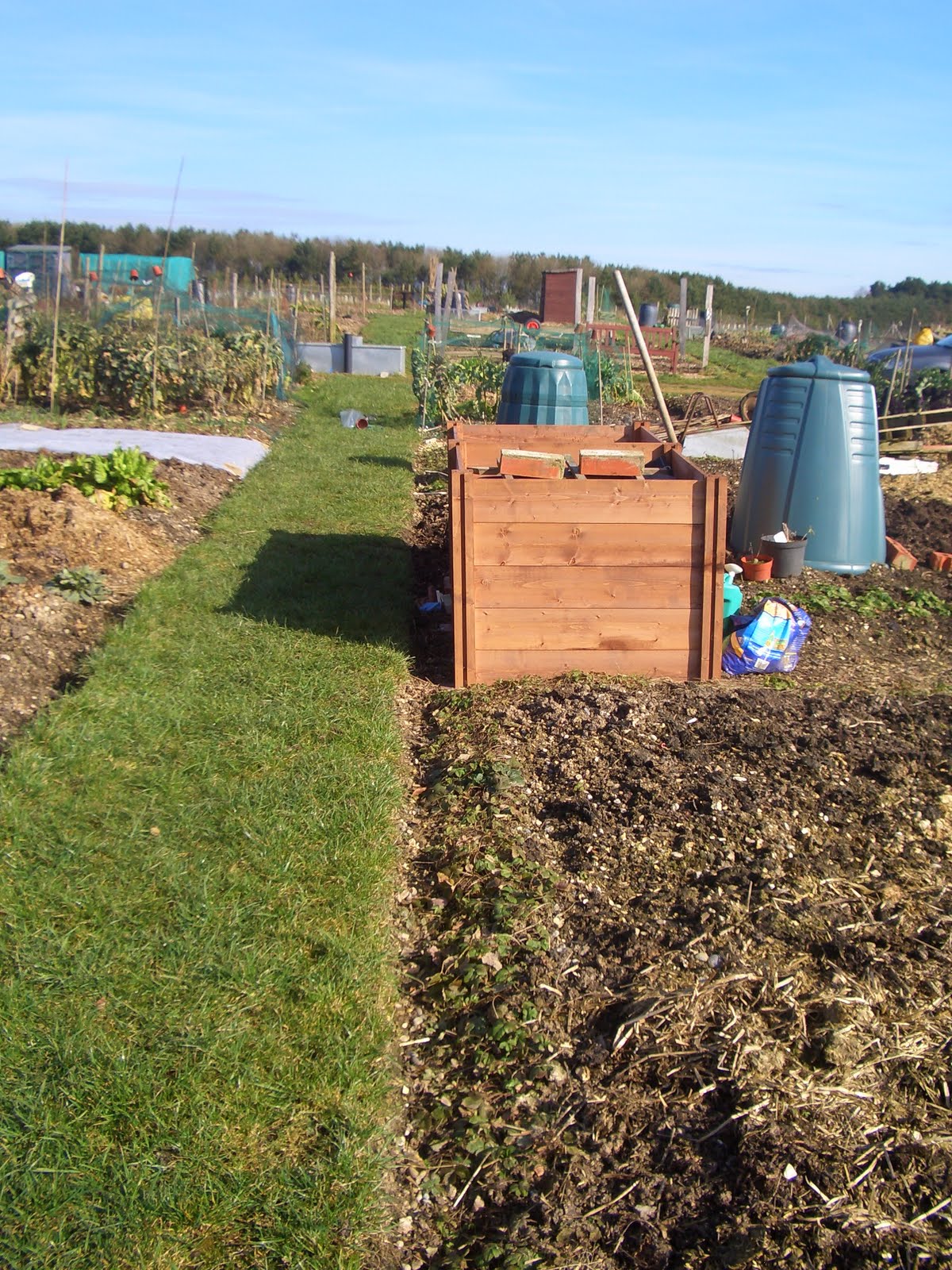
I also compost all plant waste on the site. Here you can see my two green plastic bins, and the two wooden compost containers, that are filled in rotation. By the time the fourth container is filled to the brim the first container will have produced beautiful sweet smelling, fully rotted compost, that will be fine and friable to the touch and can be spread across the allotment.

The plastic "dalek" bins are OK, but the very best compost is being made in the two square wooden bins. I bought them from The Recycle Works, they are very easy to construct from the flat packed wood, and I am delighted with the first compost from them.

Like many other "plotters" I started with a compost bin made from old wooden pallets, tied together with string at the corners - very rough and ready! These seem to be very popular - presumably because they are cheap - but they do not make good compost; there is too much ventilation, the material dries out too readily and does not heat up sufficiently to complete the decomposition process.