Showing posts with label cow manure. Show all posts

Friday, 2 September 2011

Autumn on the allotment part 1

It has been an incredibly busy month on the allotment - harvesting the results of my labour, keeping the weeds in check, carting loads of farmyard manure from the communal heap by the gate (hard work that!!) to spread on any soil as it becomes free of crops. That's the secret of weed control - keep the blighters smothered - don't give them a chance to grow when the soil is bared!
We had to get a new motor mower - each of us thought the other was keeping the oil topped up in the old one - whoops!! Don't try that yourself! So the shiny new one arrived - trouble is I cannot start it! Never had any trouble at all with the old one, even in its dying moments - in fact I can still tickle a little life out of it. But the new one? No way! What is so frustating is that hubby starts it first time every time.

Took it up to the allotment the other day anyway - but after 30 attempts and me totally exhausted, I gave up. A fellow plotter arrives - starts it first time for me!!  So I did get the grass cut.
Yesterday I thinned out the brussel sprouts plants and replanted the thinnings. I did the same with the Swiss chard, "Bright Lights" so hope to get some good crops off both through the winter, although the latter won't oblige if it snows.

Anyway, these are some photos of what it all looks like now.


Thursday, 4 November 2010

A Toad in the Netting

This warm November weather is quite amazing. Yesterday I spent several hours up at the plot generally tidying, weeding and harvesting, with just a thin tee shirt and summer weight trousers. I'm very glad I went up there because I found a toad caught in the netting around the brussel sprouts. He seemed exhausted from struggling to get free. I carefully disentangled him, gently put him amongst the strawberries where I knew I would not be working, and he seemed to recover well and crawl away beneath the leaves.
This summer I ran out of space for the courgettes, marrows and squashes, so I covered one of the paths across the plot with black cloth (the sort used to smother weeds) and piled manure onto it before covering the resulting heap with soil into which I planted the cucurbits. They thrive on this treatment - the heap becomes warm as it rots beneath the plants, and they are provided with a rich growing medium, which they love, and it doesn't dry out in the driest of summers. The benefit now at the end of the year is that I have a plentiful supply of well rotted manure which I am using to top dress all around the plot where needed - for example on the asparagus bed, around the flowers in the flower bed, and around the cabbages, sprouts, spinach, etc. which i am still harvesting.


I am well pleased with my handiwork. The plot is beginning to look very neat and tidy, ready for the quieter winter months ahead, and there is still an amazing amount of produce to see us through the next few dreary winter months.

Wednesday, 28 July 2010

More Harvest


Yesterday was dry and warm; in fact it was almost unbearably muggy and humid. But in spite of that I spent several hours at the allotment doing lots of tidying up, harvesting, getting more barrow loads of manure to spread on bare patches, trimming the grass edges and keeping any stray weeds at bay.

I dug the shallots up and rather than leaving them to dry on the surface of the soil I have brought them home and spread them in the garage to dry - I am tempted to make ropes of them in the same way as garlic, (right) to hang in my kitchen for use throughout the winter.

I also took home all the remaining cauliflowers. They are slightly damaged by caterpillars and I soaked them in a bowl of water to flush the caterpillars out. This also brought forth several earwigs. All the creatures were given a new home in the compost heap!

With so many cauliflowers to deal with, I made some soup, using home grown shallots and garlic, with vegetable stock, and blitzing the softened mixture with cheddar cheese in the liquidizer. It tastes delicious and has been frozen for the winter. Those cauliflowers not used for soup will store in the bottom of the fridge for a week or so quite happily.

Also coming up ready for harvest are several of the squashes. Many of these store well through the winter or make delicious soup for freezing. Otherwise they roast well with a mixture of other vegetables for a hearty winter meal. More about those another day.

Monday, 26 July 2010

Middleton's Gardening Guide


It cost two shillings and sixpence in "old" money - that's 12.5 new pence post decimalization! Still quite a lot of money when I was a child. But I managed to buy it and it was my gardening "bible" for all my horticultural endeavors on my vegetable plot at home.

I well recall the frustrations of not being able to afford many of the aids recommended by Mr Middleton. How could I possibly afford cloches, for instance? Or seed potatoes? Or all the pots and seed trays he assumed we had unlimited access to? Or the peat, chalk, sand, loam, sulphate of potash, to make the recommended John Innes composts?

All I had access to in abundance was free cow manure from our covered yard, where our dairy herd over wintered, and I lugged vast quantities of the stuff over to the vegetable garden, spreading it widely as well as building a huge heap on which I grew amazingly enormous marrows!

But I poured over the "Gardening guide for every week - all the year round," marking items for me to act on at the appropriate times, whilst dreaming of all the many things beyond my grasp. I used to send off for all the seed catalogues and save pocket money to buy seeds. I wish now that I had kept those old catalogues.

Sunday, 25 July 2010

Manure and compost


We are very lucky on our allotments to have an unlimited supply of horse and cow manure brought to the site by local farmers. This may be either straw or wood shavings based, and may be supplied in various stages of decomposition. We have just had the latest load delivered and as I gradually clear the crops, I am busy stockpiling barrow loads onto the bare earth ready to be spread and dug or forked in over the autumn and winter. A thick layer over the soil at this stage will keep any weeds at bay, and once dug in it also really helps to break up the heavy clay soil, improving its texture and drainage, as well as supplying plenty of nitrogen for healthy crops next year.

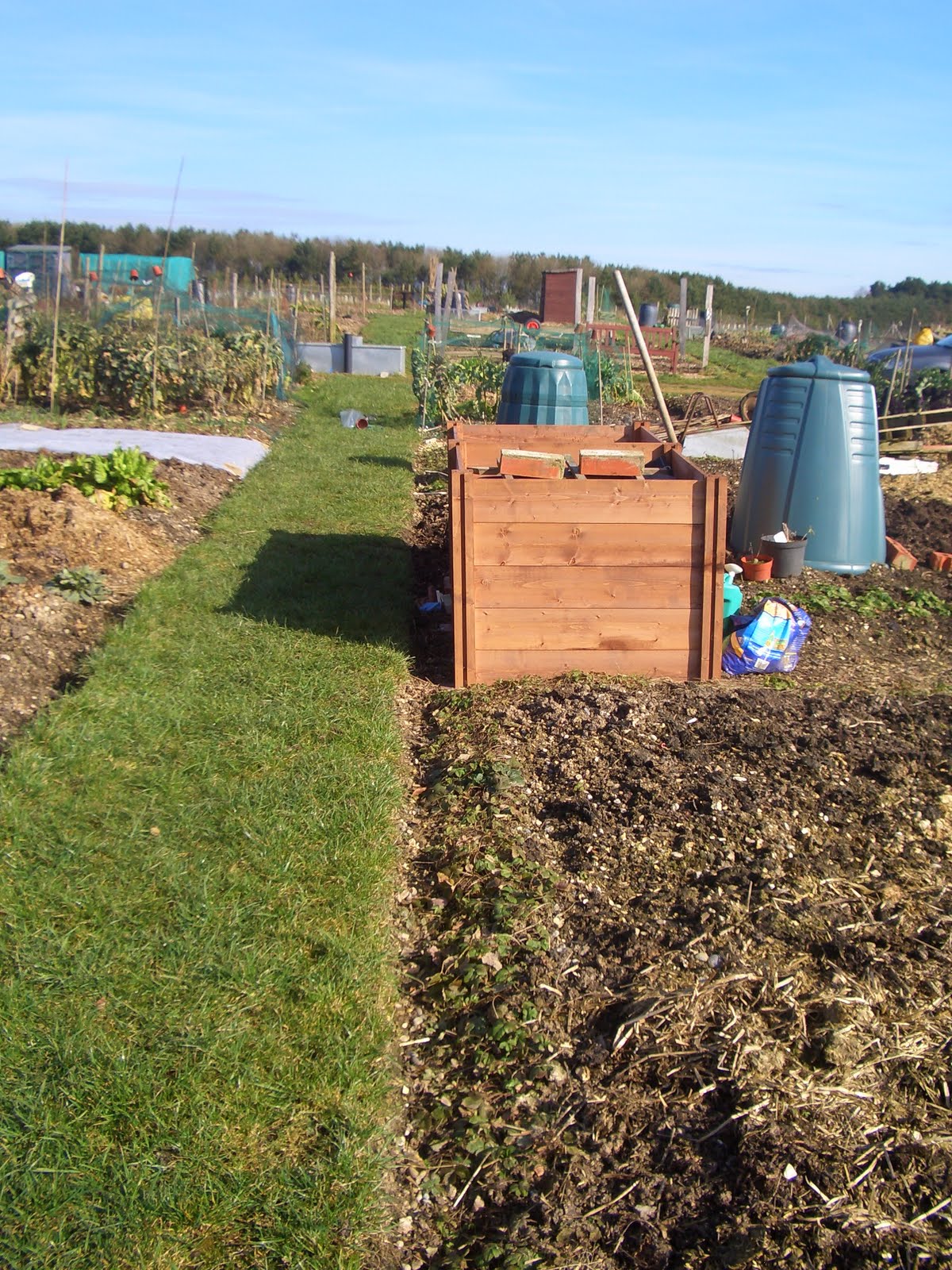
I also compost all plant waste on the site. Here you can see my two green plastic bins, and the two wooden compost containers, that are filled in rotation. By the time the fourth container is filled to the brim the first container will have produced beautiful sweet smelling, fully rotted compost, that will be fine and friable to the touch and can be spread across the allotment.

The plastic "dalek" bins are OK, but the very best compost is being made in the two square wooden bins. I bought them from The Recycle Works, they are very easy to construct from the flat packed wood, and I am delighted with the first compost from them.

Like many other "plotters" I started with a compost bin made from old wooden pallets, tied together with string at the corners - very rough and ready! These seem to be very popular - presumably because they are cheap - but they do not make good compost; there is too much ventilation, the material dries out too readily and does not heat up sufficiently to complete the decomposition process.