Showing posts with label horse manure. Show all posts

Sunday, 27 March 2011

Turning a lawn into a vegetable garden!

"I'd really love to be able to grow my own vegetables," she said. "OK", said I, and with hindsight somewhat rashly. "I'll come over next March and dig a vegetable patch in your lawn - you just show me where you want it, keep me fed and watered, and I'll do the rest."
(I would add that said friend cannot do much digging and bending - hence needing me for this heavy work). So last week there I was, looking at this large patch of grass and wondering where to start!!

First we brought out a compass and decided where the sun was going to rise and set in relation to our new plot. It is a good idea if possible to have the rows running North to South so that both sides get maximum benefit from the sun.
Having thus decided upon the best site for our vegetables, we marked out a rectangular plot running roughly West/East with canes laid upon the ground. Then I set to work.
My first joyful discovery was that the ground was beautifully light and sandy, making work very much easier. So I set to with a fork and spade and skimmed off the top layer of grass and moss and weeds. I stacked these turves upside down in an out of the way corner at the bottom of the garden, making a heap. Over the next few months this should rot down well and can be dug back into the plot perhaps as early as next year.
The downside of such sandy soil is that it will dry out very easily in summer, and is readily leached of nutrients. So before we did any more, we went out in search of horse manure. Fortunately my friend lives in a very "horsey" area, with plenty of riding stables, and it did not take us long to find one such establishment only too willing to let us take away as many sack loads as we could manage. And so we came back triumphantly with about sixteen sacks, some well rotted, some quite fresh.
And here you see the trench I then dug where we will sow the runner beans this year. This I filled with some of the fresh horse manure, and covered it with soil. The beans will love this - they are hungry for nutrients and the manure will also help hold moisture if we have a hot dry summer (wish!).

That was all an afternoon's work, and we felt well pleased with progress - but tomorrow will be another day.....

Sunday, 25 July 2010

Manure and compost


We are very lucky on our allotments to have an unlimited supply of horse and cow manure brought to the site by local farmers. This may be either straw or wood shavings based, and may be supplied in various stages of decomposition. We have just had the latest load delivered and as I gradually clear the crops, I am busy stockpiling barrow loads onto the bare earth ready to be spread and dug or forked in over the autumn and winter. A thick layer over the soil at this stage will keep any weeds at bay, and once dug in it also really helps to break up the heavy clay soil, improving its texture and drainage, as well as supplying plenty of nitrogen for healthy crops next year.

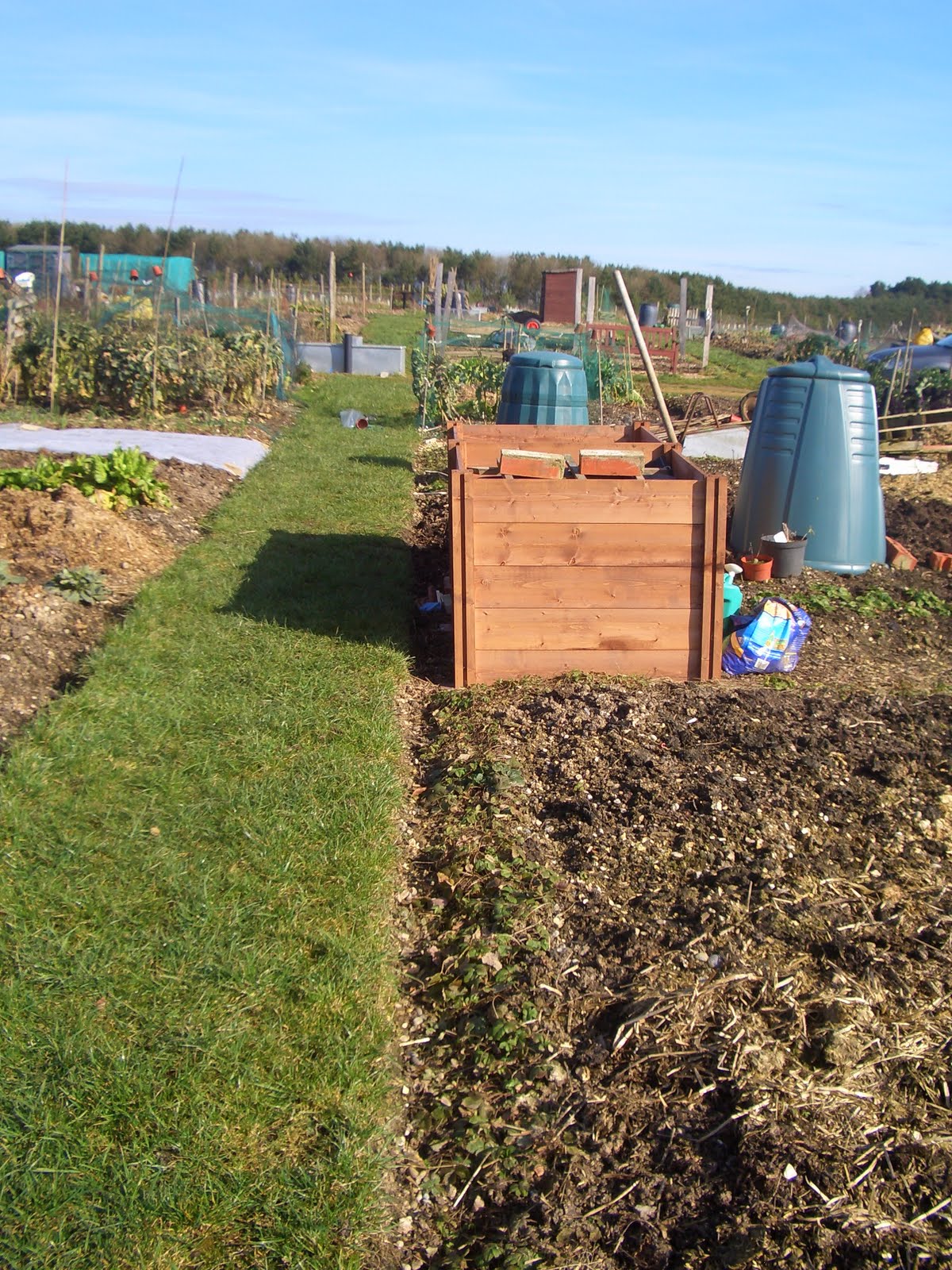
I also compost all plant waste on the site. Here you can see my two green plastic bins, and the two wooden compost containers, that are filled in rotation. By the time the fourth container is filled to the brim the first container will have produced beautiful sweet smelling, fully rotted compost, that will be fine and friable to the touch and can be spread across the allotment.

The plastic "dalek" bins are OK, but the very best compost is being made in the two square wooden bins. I bought them from The Recycle Works, they are very easy to construct from the flat packed wood, and I am delighted with the first compost from them.

Like many other "plotters" I started with a compost bin made from old wooden pallets, tied together with string at the corners - very rough and ready! These seem to be very popular - presumably because they are cheap - but they do not make good compost; there is too much ventilation, the material dries out too readily and does not heat up sufficiently to complete the decomposition process.